The Salt and the StoneThe dust has finally settled on the “Salty Crackers,” but the river air feels different now.Back in Green Cove Springs, the Morgan 51 sits quietly in her slip. She no longer looks like the desperate vessel fleeing the “Meat Grinder” of the Gulf. Under the dappled shade of the oaks, she looks like a sleeping giant, resting her bones after a war. But if you look closely at her waterline, or run your hand along the rigging, you can still feel the grit. You can still smell the salt.For the Captain, the voyage never truly ended. He’s still in the bilges, still dreaming of the Bahamas, and still chasing that “masterpiece” he knows is hidden beneath the wear and tear. He proved that a “Good Deal” could carry a family to the edge of the world, and for him, the horizon will always be calling.For me, the return to the “Stone” was more than just a homecoming. I am back to my Black Creek crew and my quiet woods, back to the dirt that stays under my fingernails and the ground that doesn’t tilt. But sometimes, when the wind kicks up from the east and the river starts to chop, I find myself looking at the depth sounder or checking the tension on the lines without even thinking.I realized that you can leave the ocean, but you can’t exactly wash the salt out of your soul.We are different people than the ones who untied those lines weeks ago. We are tougher, humbler, and perhaps a little more weary. We’ve seen the “Indigo Void” and lived to tell the tale. We’ve stood on the ramparts of a ghost fortress and navigated the “City of Masts.” We learned that family isn’t just about who you share a meal with; it’s about who you trust when the “washing machine” starts to turn.As I sit on the dock, watching the sunset turn the St. Johns River into a sheet of liquid copper, I realize that the greatest adventure wasn’t the destination. It was the Salty crackers “itself—the shared struggle, the salt-stung eyes, and the quiet satisfaction of knowing we did it. The anchor is down. The hook is set. We are home.But somewhere, out past the reef and beyond the Seven Mile Bridge, the indigo is still waiting. And next time, we’ll be ready.
Gentle Trails journal
Because every great adventure start with one easy step
-
The lines were tied, the engine was silent, and the Morgan 51 was back in her slip at Black Creek Marina in Green Cove Springs. But the quiet of the dock didn’t mean the work was over. For the “Salty Crackers,” the end of one voyage was just the blueprint for the next, and the blueprint was looking expensive.Moe sat on the deck, the familiar humidity of the St. Johns River wrapping around her like an old blanket. Across from her, the Captain, Robert, and Gordon weren’t looking at the horizon anymore. They were looking at the boat with the critical, unblinking eyes of men who had seen the “Indigo Void” and knew exactly where the armor had cracked.“She needs a total makeover, Moe,” the Captain said, his hand resting on the engine hatch. “The motor is tired. We’re looking at new valves before we even think about turning the key for a long haul again.”“And the bottom,” Gordon added, peering over the side at the waterline. “The tropical growth from the Keys is hitching a ride. She needs to be hauled out, scraped, and painted. We can’t have her dragging through the water with a beard of barnacles.”They talked of a total overhaul—stripping back the wear and tear of the Gulf, reinforcing the rigging, and upgrading the systems that had barely hummed through the heat. This adventure had been the greatest teacher they ever had. It taught them that the ocean doesn’t care about “good deals”—it only cares about preparation. They were taking every wave that had crashed over the bow and turning it into a work order.Moe listened to the clinking of tools and the tactical planning of the next several months. She realized then that for her husband, the dream wasn’t just a destination like the Tortugas—the dream was the boat itself. It was the constant tinkering, the sweat in the bilges, and the knowing that when they finally did untie those lines again, she would be stronger than the sea.“By the time we’re done with her,” the Captain said, looking over at Moe with that unmistakable glow, “she won’t just be a good deal. She’ll be a masterpiece. And then… maybe the Bahamas.”Moe didn’t protest. She looked at her hands—tougher now, stained with a little bit of salt and a little bit of diesel. She was still a prairie girl at heart, but she understood the rhythm of the river now. She would help them sand, she would help them paint, and she would wait for the tea-stained water to tell them when it was time to go.CAPTAIN’S LOG: The Refit BeginsLocation: Green Cove Springs / Home PortStatus: Secured. Project List: Infinite.The True Cost of a DreamThe Gulf is a harsh auditor. It found every weak seal, every tired hose, and every vibrating valve. I’m not discouraged, though. If anything, I’m more excited. Now I know what this boat is capable of, and I know exactly what she needs to be bulletproof. We’re going to tear her down to the bones and build her back better. A 51-foot Morgan deserves nothing less than perfection.The Crew’s New RhythmGordon and the Robert are already talking about the “next time.” That’s the sign of a real crew—they aren’t running for the hills; they’re grabbing a wrench. We’ve shared something that most people only watch on a screen. We’ve got the salt in our blood now.The Anchor in the HeartMoe is already thinking about the garden and the “Stone,” but I saw her look at the charts for the Bahamas. She’s not a passenger anymore; she’s the soul of this vessel. We’ll spend the summer under the oaks, sanding and painting until our backs ache. But when the winter winds start to blow and the river gets that certain chill… I know she’ll be the first one to check the lines.The voyage is over. Long live the voyage.
-
The ocean doesn’t give up its grip easily. We traveled the long miles of the Atlantic coast, the Morgan 51 humming a steady tune as the salt air gradually lost its tropical bite. But the moment we turned the bow inland, the world changed.Crossing the bar and entering the mouth of the St. Johns River was like stepping through a doorway into a familiar room. The water transformed. The terrifying, beautiful indigo of the deep sea faded away, replaced by the dark, tea-stained “black water” of the St. Johns river. It was rich with tannins from the roots of a million cypress trees, a liquid history of the swamps and the scrub.“Smell that?” Moe asked, standing at the bow, her eyes closed.“Mud and pines,” the Captain said, a grin finally relaxing his weathered face. “That’s the smell of the Stone.”As we moved up-river, the horizon began to shrink in the most comforting way. Instead of the endless, empty circle of the ocean, we were flanked by the green walls of the Florida wilderness. We passed the familiar markers, the docks of small river towns, and the silent, watchful herons standing like statues in the shallows.The Morgan looked different here. In the Tortugas, she was a rugged survivor, a speck of white against a world of blue. Here on the river, she was a majestic queen. Her tall mast reached up toward the Spanish moss hanging from the oaks, and her broad beam felt solid and secure between the riverbanks.Moe felt the tension leave her shoulders for the first time in weeks. Out there, the water was an enemy you had to respect. Here, the water was a neighbor. She watched the gators slide off the muddy banks—old friends in the shadows—and felt the “itch” of the river finally begin to soothe. Robert and Gordon were already leaning over the stern, pointing at the salt-corroded hardware and the wear on the running rigging. They weren’t talking about the deep sea anymore; they were cataloging the chores of the river. There were seals to be replaced, solar panels to be re-angled for the northern sun, and a list of “must-fixes” that had grown with every wave in the Gulf. The salt was being washed off the decks by the brackish spray of the river, replaced by the familiar film of freshwater silt, and the spirit of the family was being renewed by the proximity of the earth.“We’re almost there,” Gordon said, pointing toward the bend that would lead them toward Green Cove and Black Creek Marina.Moe nodded. They were still on the boat, still floating on a dream that wasn’t entirely hers, but the river was whispering a promise. The indigo void was behind them. The red bricks of the Fort were a memory. They were coming home.CAPTAIN’S LOG: Back in the Black WaterLocation: St. Johns River / Heading South to Green Cove SpringsStatus: Engine temp nominal. Heart rate steady.The Sweet Water ShiftThe moment the depth sounder stabilized and the waves died down, the Morgan felt like she was sighing. Sailing the ocean is like running a marathon; sailing the river is like a slow walk through the woods. The water is that deep, coffee-colored brew I grew up on. It doesn’t have the clarity of the Keys, but it has a soul. You can feel the history of the land in this current.The Captain’s PeaceI looked at Moe at the bow. She looks younger today. The “Sea Ghost” that was haunting her in the Indigo Void has been replaced by the “River Girl.” She’s home. I’ve completed the mission. I took the “Salty Crackers” to the edge of the world and brought them back in one piece. The boat is salt-crusted and the rigging is tired, but we’re home.The To-Do ListNow that the adrenaline is fading, the “Good Deal” is showing its age. The Gulf took its toll. Me ,Gordon and Robert are already planning the repairs. That’s the life of a boat owner—you’re either sailing or you’re fixing. But today, I don’t care about the leaking seals or the corroded wire. I just want to see my dock.Shutting down the radar. We don’t need electronics to find our way now. We just follow the scent of the pines.
-
The Captain finally saw it—the restless look in my eyes that no amount of turquoise water could cure.
He knew the “Salty Dream” had been shared, but he also knew his wife was ready for the river.
When he looked at the charts and saw a window of clear weather for the trek up the coast, he didn’t fight it.
He just nodded, and the familiar dance of departure began.”We’re going back to the dock, Moe,” he said, and that was the sweetest thing I’d heard in weeks.
Pulling out of Boot Key felt like escaping a cage. As the forest of masts shrank behind us and we cleared the final bridge, the Morgan 51 seemed to settle into a new rhythm.
She was no longer fighting the “square waves” of the Gulf; she was a horse heading back to the barn.The run up the coast was a different kind of sailing.
We weren’t hunting for a fortress in the middle of the sea anymore; we were tracing the edge of the world we knew. We passed the high-rises of Miami and the glittering lights of Fort Lauderdale, but they were just shadows in the distance.
My eyes were fixed further North, past the inlets and the sandbars, looking for the place where the salt air starts to give way to the scent of the swamp.
The weather held, but the ocean was still the ocean. It was a long, tiring haul. With just the four of us, the watches felt longer, and the fatigue of the weeks at sea was starting to settle into our bones. I spent my hours at the helm thinking about the contrast of this trip—the “Majestic” beauty of the Tortugas and the “Relentless” noise of the Keys.
I’d learned I could handle the indigo void. I’d learned I could trust a piece of fiberglass in a gale. But I also learned that an adventure is only as good as the home you have waiting for you at the end of it.”Look at the water,” Gordon said on the second day.
“It’s changing.”He was right. The neon blue of the Gulf Stream was deepening, turning into a darker, richer hue. We were leaving the tropics behind. Every mile we covered brought us closer to the brackish waters where the dolphins are replaced by the gators and the coral is replaced by the cypress knees.
The Captain stayed at the wheel for hours, his face set in a mask of quiet satisfaction. He’d done it. He’d bought the “good deal,” he’d sailed his family to the edge of the world, and now he was bringing us back. The glow was still there, but it was softer now—the look of a man who had tested his dream and found it held water.
-
A week in Boot Key Harbor feels like a month when you’re a woman who values her privacy.
The Captain was busy “talking boat” with every sailor within shouting distance, but I was busy watching the weather and the neighbors.
In a harbor that is crowded, you aren’t just responsible for your own anchor; you’re at the mercy of everyone else’s.
One night, the wind kicked up to a steady twenty knots, whistling through the masts like a haunted flute. I stayed top-side, wrapped in a blanket, watching a weathered trawler just twenty yards away.
Their anchor was dragging, inch by inch, toward the Morgan 51.”We’re going to have to move,” I whispered into the dark, but the Captain was deep in a well-earned sleep.
I sat there, a prairie girl standing guard in a floating city, feeling the deep irony of it all. People come to the Keys to “get away from it all,” but they end up packed tighter than sardines in a tin.
I looked at the lights of the bars on shore and the glow of a thousand cabin windows.”Too many people, Yote,” I muttered, patting the dog.
Yote just huffed. She was over it, too. She wanted a yard and a squirrel to chase that didn’t require a dinghy ride to reach. We were all just waiting—waiting for the wind to lay down, waiting for the Captain to get his fill of “salty stories.” The “Magic” of the Keys had worn off for me.
I didn’t want a sunset celebration or a crowded tiki bar. I wanted the smell of damp earth after a rain and the sound of nothing but the wind in the pines. I realized then that an adventure isn’t just about where you go; it’s about learning exactly where you belong. And I didn’t belong here.

-
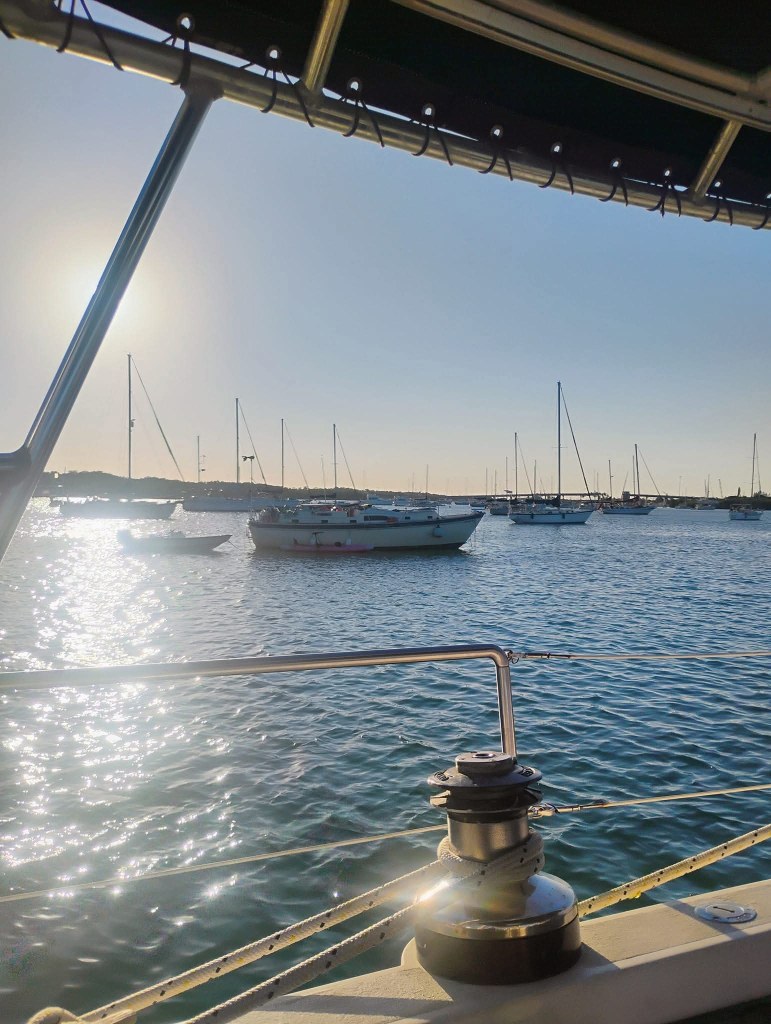
There she is,” the Captain said, a tired smile finally breaking through his grit.But the relief was short-lived. Our destination wasn’t a quiet hammock swaying between two palms; it was Boot Key Harbor.
Pulling into Boot Key is like navigating a landmine field.
It’s a city of masts, a floating parking lot where boats are anchored so thick you could almost walk across the harbor without getting your feet wet.
To a girl raised on the wide-open Kissimmee prairie, where you can go all day without seeing another soul, this was claustrophobia on the water.”
Look at all these boats,” I muttered, my hands tight on the rail. “It’s overcrowded and noisy. It feels like a beehive that’s about to swarm.””It’s the community, Moe,” the Captain said, his eyes glowing with the atmosphere.
“This is where the ‘Salty Dreams’ come to roost. These people have crossed oceans to be exactly where we are right now.”That was the problem.
Some people live for the “Key West” vibe—the constant chatter on the VHF radio, the sundowners at the marina, the feeling of being part of a floating tribe.
I am not one of those people. I love the adventure, but I don’t like the crowd.
I’m a creature of the scrub; I prefer the company of a hawk or a gator over a hundred “lost souls” in flip-flops sharing stories of broken impellers.
The week at Boot Key was a test of my patience. The wind didn’t quit, howling through the rigging of a thousand boats like a thousand discordant flutes.
Because the harbor was so packed, we had to stay on constant guard. In the middle of the night, you’d hear a shout and the splash of an engine—another boat’s anchor had given way, sending them drifting toward their neighbors in the dark.
I tried to fit in. I went to the marina, I walked the docks, I tried to smile and talk about “points of sail” and “nautical miles.”
But it felt like wearing a pair of boots that were three sizes too small. Every “Hello, Captain!” from a passing dinghy felt like an intrusion.
I didn’t belong to the salt-crusted social club. I was a prairie girl trapped in a tourist trap.
I looked at the Captain. He was in his element, his face lit up as he talked shop with other sailors.
This was his dream, and seeing that glow in him made the noise and the crowds bearable for a while. But as I looked north, my heart began to drift.
I thought of our quiet dock back in Green Cove Springs.I thought of the oak trees draped in Spanish moss, the heavy silence of the St. Johns River at dawn, and the feeling of dirt that stayed under your fingernails and stayed still under your boots.
Out here, everything was fluid, loud, and temporary. I realized then that while the Captain was finally home, I was just a visitor in a world made of salt.
-
After hours of being tossed in the gray washing machine of the Gulf, a thin, low line finally broke the horizon. It wasn’t just a cloud or a trick of salt-stung eyes. It was Key West.As we skirted past the southernmost point, the sight of the island was bittersweet. We could see the distant glint of traffic and the rooftops of houses—the “Stone” was right there, tantalizingly close. But for a sailor, seeing land isn’t the same as reaching it. We weren’t stopping. We had to keep pushing east, running a race against the weather that was still snapping at our heels.”There it is,” the Captain shouted over the wind, pointing toward the cluster of lights. “But don’t get comfortable. We’ve still got miles of reef to thread before we can tuck in.”Seeing Key West brought a surge of relief that acted like a shot of adrenaline to my sea-sick soul. It was the first sign that we had survived the crossing of the deep. But the relief was tempered by the reality of the map: we still had hours of open water ahead of us. We were “inside” the reef now, but the sea was still confused, and the boat continued its violent dance.The next landmark we prayed for was the Seven Mile Bridge.In a car, crossing that bridge is a scenic seven-minute drive. On a boat in a building sea, it feels like an epic journey. We watched for the massive concrete spans to rise out of the haze, a gray ghost looming over the whitecaps. To me, the Seven Mile Bridge was the gateway. Once we saw it in the shadow, we’d be in the home stretch for Boot Key Harbor.”Just hold on a little longer,” I whispered to myself, my hand white-knuckled on the railing.The salt spray had crusted in my hair, and my stomach felt like it had been wrung out and left to dry, but the sight of the bridge gave me a target. Every mile we put behind us was a mile closer to anchoring and hitting a little land. Every time the bow dipped, I pictured the calm, protected waters of the harbor.We were battered, I was still fighting the nausea, and the crew was exhausted—but the sight of the Keys had given us hope. We were no longer lost in the Indigo Void; we were following the breadcrumbs of civilization back to the Stone.The sun began to dip, casting a bruised purple light over the water as the bridge finally drew level with our beam. It was a monument of human engineering standing defiant against the tide. As we passed under the high span, the hum of tires on the pavement above sounded like music—the sound of a world that didn’t tilt, a world where things stayed where you put them.We were through the gate. But as the lights of Marathon began to twinkle in the distance, I realized that surviving the crossing was only half the battle. Now, we had to find a place to rest in a world that never seemed to stop moving.
-
If the journey to the Fort was a test, the journey back to Boot Key Harbor was a war. The “Indigo void” had lost its beauty and replaced it with a mean, gray temper.We weren’t just sailing; we were running. The weather window was closing fast, and a massive system was breathing down our necks, chasing us across the Gulf.The “Green Room” reclaimed its victims early. Moe wasn’t just tired this time—she was trulysick.The square waves were back, but they were bigger, steeper, and more frequent. Every time the Morgan 51 climbed a wall of water and slammed into the trough on the other side, the shudder went through the hull and straight into her bones.”I don’t think I’ve ever been this miserable,” Moe groaned, clinging to the edge of the cockpitseat.The world became a blur of nausea and gray spray.The Captain was at the helm, his face set in stone. He knew that if the storm caught us in the open, the “washing machine” would turn into a meat grinder. We had to push the boat harder than we ever had. The sails were reefed tight, and the engine hummed at a high, desperate pitch, trying to keep us ahead of the squall lines visible on the radar.For Moe, time ceased to exist. Minutes felt like hours. She wasn’t watching for dolphins oradmiring the blue; she was just trying to breathe. The salt air that felt refreshing days ago nowtasted like copper and sweat.Every roll of the boat was a reminder of how little control she had.”Just a few more hours,” the Captain would say, but his voice sounded like it was coming from amile away.We were a skeletal crew, battered and salt-soaked, fleeing toward the safety of the Keys. The “Salty Crackers” were crumbling. We had survived the frontier, but the Gulf was determined tohave the last word. The only thing keeping us going was the thought of Boot Key.
-
The moon was nothing but silver, and the stars were blotted out by a heavy, low-hanging ceiling of clouds. Once again, we were pulling anchor in the “Ghost Hour.”I am a woman of the prairie—I like to see the horizon, I like to see the snakes in the grass, And like to see the weather before it hits me.Sailing in the dark feels like walking through a thick hammock without a lantern, I prefer the solid ground; I’m not a fan of the darkness on the open sea. It swallows everything.” It swallows the distance and leaves you with nothing but the sound of the hull slapping the waves and the eerie glow of the instrument panel.”Trust the charts, Moe,” the Captain said, his voice steady. “And trust the boat.”I stood in the cockpit, my hands shoved deep into my pockets to hide the slight tremor. I didn’ttrust the dark, but I put my absolute trust in the Captain. He had spent his life reading the oceanand the river, and he was reading this black void with the same calm focus.The Morgan 51 groaned as she turned her bow toward Marathon. The crossing back wasn’tgoing to be the “Florida Magic” we had on the way out. The wind was quartering, hitting us at anangle that made the boat roll and pitch. Without the kids and the baby on board, the silence washeavy, filled only by the mechanical thrum of the diesel and the whistle of the wind through therigging.I looked back at the fading light of the Fort Jefferson lighthouse. It flickered like a dying candlebefore finally slipping away. We were officially in the “In-Between” again. Every shadow on thewater looked like a rogue wave; every change in the engine’s hum made my heart skip a beat.”You’re doing fine, Mom” Gordon said, clapping a hand on my shoulder. “Just keep your eyes onthe compass.”I realized then that this was the final lesson of the voyage. Back home, I was the one incontrol—I knew every slough and every oak ridge. Out here, in the pitch black of the Gulf, I hadto surrender. I had to trust the men, the hull, and the God who made the wind.We were four souls on a 51-foot island, carving a path through the dark toward a home that felta thousand miles away. The salt was stinging my eyes, and the cold was seeping into mybones, but I stood my watch. This old prairie girl wasn’t going to let the dark win.She looked at her hands—they were red, calloused, and smelled like diesel and rope. A fewweeks ago, these were the hands of a woman who tended a garden in the scrub. Now, theywere the hands of a sailor. We were battening down the hatches, not just on the boat, but in ourspirits. The easy part of the vacation was over. The journey back was going to be earned.We were a lean crew now, down to the essentials. We ate a quick, silent meal, knowing thatsleep would be a luxury we wouldn’t see for a long time. The wind was already starting towhistle through the rigging, a low, haunting note that signaled the beginning of the end of ourjourney.
-
The magic of the Fort was tempered by a harsh reality: the sea doesn’t care about your plans.While we had spent the last few days living like island royalty, the weather charts were beginning to tell a different story. A system was moving in, and the “Indigo Void” was about to wake up. Then, the situation turned personal. Asher, our brave little king of the castle, wasn’t feeling right.A small fever had taken hold, making his skin hot to the touch and his eyes heavy. The heat, the constant motion of the boat, and the lingering effects of the “Green Room” had finally caught up to him. He was quiet and drained, his usual spark replaced by a stillness that didn’t belong to a young boy.Moe and Catherine and Andrew looked at the Captain, then at the graying horizon. The thought of putting a child who was so run-down and feverish through another sixteen to twenty hours of “square waves” was more than they could stand. A choice had to be made—the kind of choice that pits a grandmother’s and parents’hearts against a mariner’s mission.”We can’t take him back on the boat,” Moe said, her voice leaving no room for argument. “Not with a fever. Not like this.”The “Hard Choice” was made. We wouldn’t all be sailing back together.The next morning, we stood on the dock as the seaplane—a rugged de Havilland Twin Otter—bobbed in the turquoise water. It felt like a scene from a movie, but the lump in Moe’s throat was very real. Catherine, Andrew, and Asher boarded the small plane. As the engines roared to life and the floats lifted off the water, the Morgan 51 suddenly felt a thousand feet long and painfully empty. We watched until the plane was nothing more than a silver speck in the sky, heading back toward the “Stone” and the safety of land.”Well,” the Captain said, his voice unusually quiet as he looked at the remaining crew. “It’s just us now.”Only four remained to sail the beast back to Marathon. The laughter of the grandson was gone, replaced by the ominous whistle of the rising wind in the rigging. The family had been split, the manifest was shortened, and the journey home was looming. We were still “Salty Crackers,” but the sweetness of the trip had been replaced by a grim determination. It was time to batten down the hatches and face the Gulf once more.


