Jacob was a young soldier from Florida who served during World War I. His life and service reflect a bittersweet chapter of American history where many soldiers were lost not just to combat, but to the harsh conditions of military training camps.
Military Service and Life
Rank: Corporal
Unit: Company K, 124th Infantry Regiment (part of the “Dixie Division”)
Birth: October 22, 1896
Death: April 17, 1918
Jacob was born in Florida and was a member of the Florida National Guard before it was federalized for the Great War. Records indicate he was a dedicated soldier; just weeks before his death, he had been back home in Florida on recruiting duty, helping to build the forces that would eventually head to Europe.
A Tragic Loss at Camp Wheeler
Jacob did not die on a foreign battlefield, but at Camp Wheeler in Macon, Georgia. During 1917 and 1918, military camps were hit hard by outbreaks of disease.
Cause of Death: He passed away from cerebrospinal meningitis.
A Family Presence: In a touching detail, historical accounts mention that his father, Jacob Stonebraker Sr., was at his bedside when he passed.
Brother in Arms: He served in the same company as his brother, George Thomas Stonebraker, who held the rank of Sergeant.
The Headstone’s Message
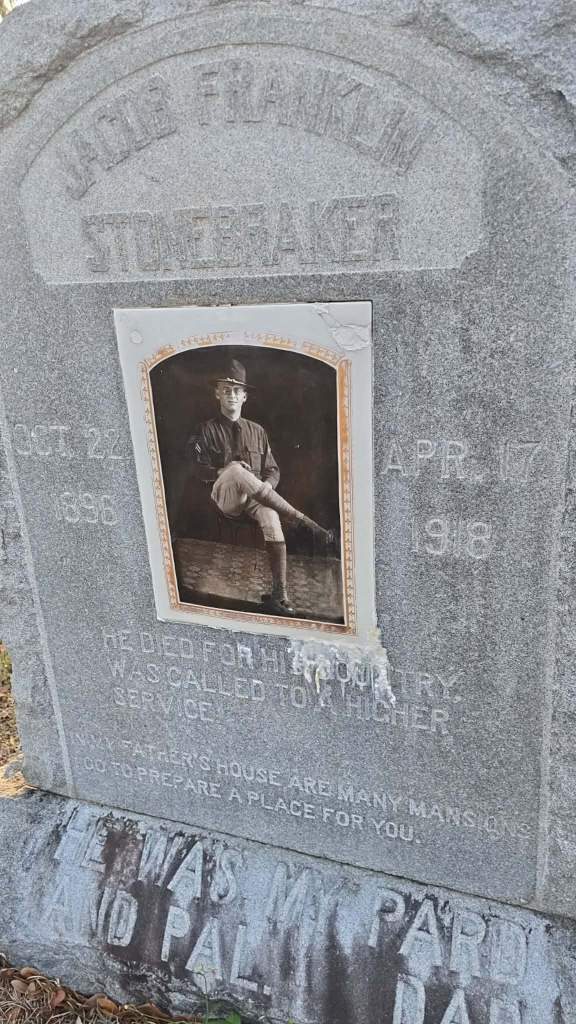
The inscriptions on his monument in Oak Ridge Cemetery (Arcadia, Florida) paint a picture of a deeply loved young man:
“He was my pard and pal — Dad”: This informal, heartfelt note at the bottom of the stone is particularly rare for the era, suggesting a very close bond between father and son.
“He died for his country, was called to a higher service”: This reflects the community’s view of his sacrifice, acknowledging that his service at home was just as vital as service abroad.
Biblical Reference: The quote “In my Father’s house are many mansions…” is from John 14:2, a traditional verse of comfort.
Jacob’s portrait, preserved on the stone, shows him in his “doughboy” uniform—a sharp contrast to the tragic reality of his early death at just 21 years old.
A Florida boy in doughboy brown,
Before the ships were Europe-bound.
No trench, no wire, no foreign shore,
But still a casualty of war.
“He was my pard,” the granite cries,
Where Jacob Franklin Stonebraker lies.
A father’s grief, a silent camp,
A life snuffed out like a guttered lamp.
No thunder of guns or whistles of shells,
Just a fever that rose where the shadows fell.
In the crowded tents where the “doughboys” lay,
A silent invader stole Jacob away.
It crept through the camp on a winter’s breath,
A sudden, sharp sickness that hurried toward death.
Before he could sail for the fields of France,
The fever had ended his soldier’s advance.
A Note on the Disease
Cerebrospinal meningitis was a terrifying reality in WWI training camps. Because thousands of young men were brought together from different regions into crowded barracks, their immune systems were exposed to new bacteria all at once. It moved so quickly that a soldier could be healthy at breakfast and in critical condition by sunset.


 Gentle Trails journal
Leave a comment