The prairie was a world of life and growth, but here, in the middle of the sea, we were learning the beauty of the bones.Life at the Fort settled into a rhythm that was half-paradise, half-pioneer. With the boat securely anchored, the guys decided it was time to provide for the crew. They spent the morning pulling up snapper, the silver-pink fish flashing in the sun as they came over the rail. But after a while, the “easy” fishing stopped.Something was down there.Every time they hooked into a good-sized snapper, the line would suddenly go heavy—dead heavy—before snapping like a piece of thread. “Something’s stealing our dinner,” Gordon muttered, peering into the crystal-clear depths.Later that afternoon, the heat became an entity of its own, thick and heavy. Gordon and Robert decided they’d had enough of being “dry crackers” and jumped into the water for a swim. They were splashing around, enjoying the cool relief, when the water seemed to shift. A shadow, darker and wider than any shark they’d seen, began to drift out from beneath the hull of the Morgan 51.”SHARK!” someone yelled from the deck.Gordon and Robert didn’t wait to check the ID. They scrambled up the swim ladder like their lives depended on it, hearts hammering against their ribs. But as the silhouette moved into the sunlight, we realized it wasn’t a shark.It was the King.An ancient Goliath Grouper, the size of a small Volkswagen, had taken up residence directly beneath our keel. He moved with a slow, terrifying majesty, his scales scarred by time and his eyes the size of dinner plates. He wasn’t interested in the swimmers; he was just waiting for the next snapper to be delivered on a silver hook. He looked up at us with a cold, prehistoric gaze, as if to remind us that while the Morgan might be 51 feet of fiberglass, he was the true master of this territory.”I think we’re parked in his garage,” the Captain laughed, though he didn’t jump in for a swim himself.The rest of the day was spent in a more respectful exploration. We geared up for scuba diving among the ruins of the old docks nearby. Underwater, the world was a cathedral of coral and rusted iron, teeming with life that didn’t know the meaning of a “fence.”We swam through clouds of tropical fish, but in the back of Moe’s mind, she could still feel the presence of the King sitting in the shadows of our hull. We were guests in a wild kingdom, and the King beneath the keel was making sure we didn’t forget it.
Gentle Trails journal
Because every great adventure start with one easy step
-
t
The afternoon sun began to dip, a strange transformation took place. The Yankee Freedom ferry, which brought the day-trippers from Key West, sounded its horn and pulled away from the dock. We watched from the ramparts as the crowds vanished, leaving only a handful of “Salty Crackers” and a few other rugged cruisers behind.
Suddenly, the Fort didn’t feel like a tourist attraction anymore. It felt like a tomb.We spent the next few hours exploring every inch of the massive structure. We climbed the winding spiral staircases made of cold granite and walked the long, echoing galleries where cannons once stood guard. Every footstep seemed to wake up a ghost. You could almost hear the rattle of chains from the prisoners—like Dr. Samuel Mudd—who were left to rot in this beautiful, heat-soaked hell.
“It’s like living the ‘old ways,’” the Captain remarked, his voice dropping as the shadows grew long.There was no electricity out here, no hum of a refrigerator, no glow of a TV. As the “Ghost Hour” set in, the only light came from the fading orange glow of the sunset hitting the bricks. We walked the moat wall, the water on one side a dark, swirling mystery and the massive walls on the other side a silent witness to history.
When the stars finally came out, they didn’t just twinkle; they exploded. Without the city lights of the mainland, the Milky Way smeared across the sky like spilled milk on black velvet.Moe sat on the deck of the Morgan later that night, looking back at the dark silhouette of the Fort. In the silence, you could feel the weight of everyone who had ever been stranded there—soldiers, prisoners, and shipwrecked souls. But as the family huddled together in the cockpit, sharing a meal under the starlight, the ghosts didn’t feel threatening. They felt like company. We were a part of the Fort’s story now—just another group of travelers seeking shelter in the red-brick miracle.The prairie was a world of life and growth, but here, in the middle of the sea, we were learning the beauty of the bones.
-
We piled into the dinghy, a tangled mess of legs, life jackets, and a very impatient scrub dog. The Captain pulled the starter cord, and the little outboard motor buzzed like a hornet as we skimmed across the neon turquoise water toward the Fort Jefferson Beach.
As we drew closer, the scale of the place hit me. Those sixteen million bricks didn’t just look like a fortress; they looked like a promise of stability. When the dinghy finally bumped against the soft, white sand of the beach, I didn’t wait for a hand out. I swung my legs over the side, splashing into the warm shallows, and hauled the bow further onto the shore.
When Moe’s boots finally hit the solid earth, the world did a strange, dizzying dance. My brain was still convinced we were on the Morgan 51, pitching and rolling over square waves. I stood there, legs braced wide, waiting for the beach to tilt. When it stayed perfectly, stubbornly still, my inner ear threw a tantrum.
I felt like a drunk sailor trying to walk a straight line on a moving train. My “land legs” were gone, replaced by a permanent sea-sway that made every step a challenge.But Yote didn’t have that problem. The moment her paws hit the sand, she transformed. The salt-crusted, weary dog of the “Indigo Void” vanished, replaced by a blurred streak of brown fur. She took off in what we call “the zoomies,” running in tight, frantic circles on the beach, kicking up sand and barking at the sheer joy of something that didn’t move beneath her.
She was reclaiming her territory, one grain of sand at a time.I walked over to the massive outer wall and pressed my palm against the warm, rough surface of a red brick. It was solid. It was sun-baked. It was real.”We made it,” I whispered.The rest of the family scrambled up behind me, Asher leading the way with a shout of “I’m the King of the Castle!” We stood there for a moment, a bedraggled group of “Salty Crackers” looking back at our boat anchored in the distance.
The Morgan looked small against the vastness of the Gulf, but she had delivered us. We had brought the prairie to the deep, and for the first time in what felt like years, the ground under my feet was exactly where it was supposed to be.
-
After twenty hours of being tossed like a cork, the transition into the lee of the island was jarringly peaceful.The roar of the wind died down, and the Morgan 51 began to glide over water that looked like liquid glass.
We were land-starved, salt-crusted, and ready to stop moving.But the Captain wasn’t done yet. The anchorage was dotted with other boats—sleek catamarans and rugged cruisers that had already claimed their spots.
“I don’t want to be near ’em,” Moe said, her voice firm. She’d spent twenty hours trusting the ocean, but she wasn’t about to trust another sailor’s knots. “If the wind kicks up and their anchor doesn’t hold, I don’t want ’em sliding into us. Give me space.”The Captain nodded, steering the Morgan toward a lonely patch of turquoise sand a good distance from the crowd.
He signaled to the first mate at the bow.”DROP IT!”The sound of the heavy iron anchor plunging into the water was the most beautiful music Moe had heard all day. We watched as the chain rattled out, sinking through the crystal-clear water until the anchor bit deep into the white sand below.
The Captain backed down on the engine, setting the hook until the boat snubbed tight.Silence.It was silence so heavy you could almost feel it. No engine rumble, no crashing waves, no whistling rigging.
Just the sound of our own breathing. And then, there was Yote. Our scrub dog had been a champion through the crossing, but she was done with the “Indigo Void.” She stood at the lifeline, her fur crusted white with salt, her nose twitching as she caught the scent of the dry ground just a few hundred yards away.
She let out a low, impatient whine, looking from the Fort to the Captain as if to say, “I’ve done my time. Get me to the Stone.”She was a “Salty Dog” now, a survivor of the Gulf, but like Moe, she was a creature of the earth. We lowered the dinghy into the water, the first step in our transition from mariners back to land-dwellers. We had crossed the desert of the sea, and now, the red bricks and the white sand were calling our names.
-
The fatigue had become a heavy fog over the cockpit.
The sun was beating down, the salt was itching under our skin, and the endless blue had started to feel like a prison. Then, a voice cracked through the wind, sharp and electric.
“LAND HO!” The shout came from the Captain and the boys. . Asher, who had been curled up in a nest of blankets, bolted upright. His little hands shot toward the ceiling in a gesture of pure triumph.We all scrambled to the lifelines, squinting against the glare of the Gulf. At first, it looked like nothing more than a tiny, dark blemish on the horizon—a speck of dust on a blue lens.
But as we drew closer, the “dust” grew into a massive, hexagon-shaped fortress. Fort Jefferson was rising out of the ocean like a red-brick mirage.
To anyone else, it was a historical ruin in the middle of nowhere. But to a boat full of “Salty Crackers,” that fortress was the most beautiful site on earth. It was Stone. It was solid. It was a man-made island of stability in a world that wouldn’t stop moving.”Motor’s going on,” the Captain announced.
The rhythmic thrum of the diesel engine joined the wind, giving us that final push.As we approached, the colors began to shift. The deep, terrifying indigo gave way to a glowing, neon turquoise so clear you could see the shadows of the clouds on the sandy bottom. The massive walls of the Fort, built with sixteen million red bricks, towered over the water, glowing in the afternoon sun.
Moe felt a lump in her throat. We had done it. We had crossed seventy miles of open water, fought the square waves, and survived the “Green Room” to find this sanctuary.The Captain stood at the helm, a quiet pride in his eyes. He had navigated his family and his 50-ton dream to the edge of the world. The Stone had won. The bricks were waiting. And for the first time in twenty hours, Moe allowed herself to believe that the ground might actually stay still again.
-
The Gulf didn’t just want to test our stomachs; it wanted to test our patience. To a landlubber, a boat moves in a straight line, but the wind had other plans for the Morgan 51.
To keep the sails full and the boat stable, the Captain had to “tack,” zig-zagging across the map like a needle stitching a quilt. Every mile forward felt like two miles sideways.
It was an indigo marathon, and the finish line was nowhere in sight.”Are we there yet?” Asher asked for the hundredth time.”Not yet, little man,” Gordon replied, his eyes scanning the water. “But look at the neighbors.”
Suddenly, the gray-blue surface of the water shattered. A pod of dolphins appeared out of the deep, their sleek bodies slicing through the waves to ride our bow wake.
They looked up at us with clicking whistles, as if they were wondering why these slow-moving land creatures were so far from their trees.Then came the flying fish. They burst from the crests of the square waves like silver grasshoppers, gliding for impossible distances before vanishing back into the blue.
To Asher, it was a circus. To Moe, it was a reminder that we were trespassing in a world that didn’t belong to us.The sun climbed high, turning the indigo into a blinding, liquid sapphire.
The beauty was undeniable, but the fatigue was settling into our bones. The “Salty Crackers” were starting to look a little worn around the edges. We were seventy miles from the nearest brick, seventy miles from a solid chair that didn’t try to throw you off, and seventy miles from a tree.
“Thirty miles to the Fort,” the Captain announced, checking the charts.Thirty miles. In a truck, that’s a thirty-minute run to the store. Out here, at six knots against a stubborn current, it was a lifetime. Moe gripped the railing, her knuckles white. The ocean didn’t look majestic anymore; it looked hungry. Every time the Morgan plunged into a trough, the water rose up like it wanted to swallow the deck.We were tired, we were salt-crusted, and we were land-starved. We were praying for a miracle made of red brick to rise out of the empty circle of the world.
-
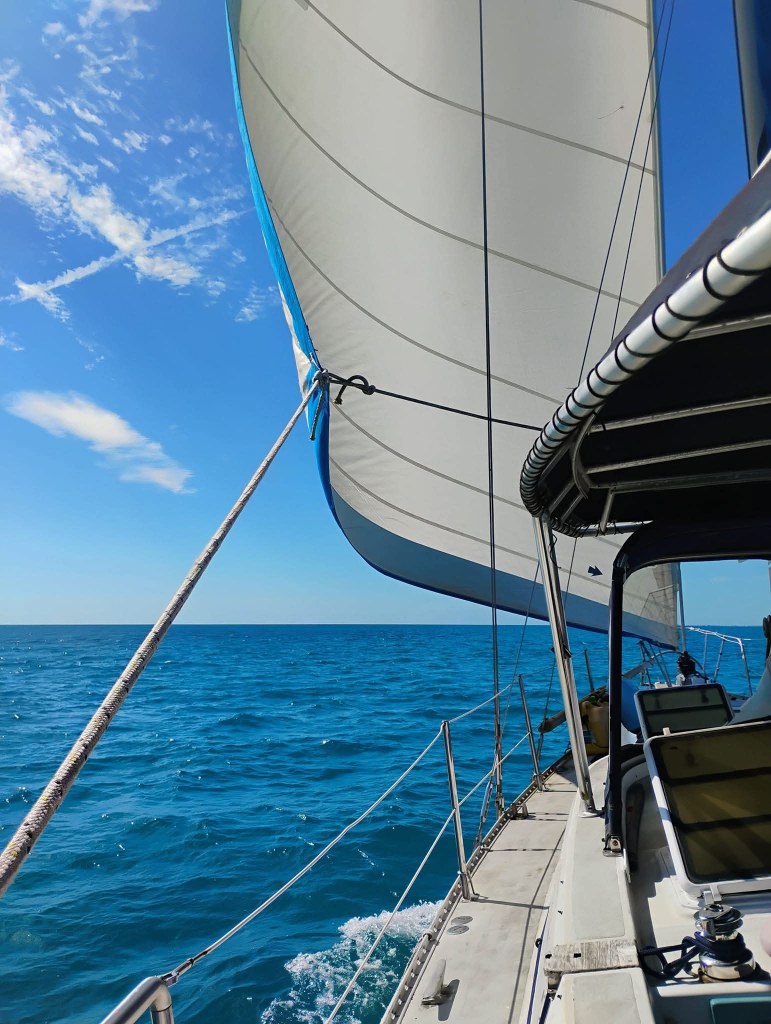
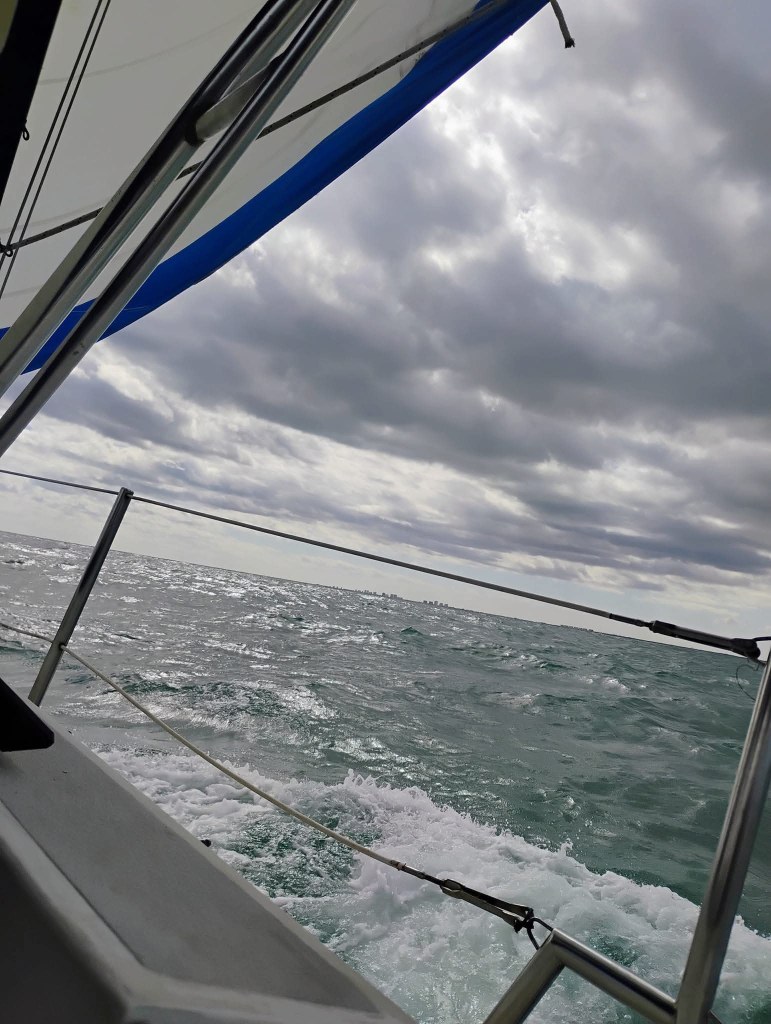
The Gulf of Mexico has a way of humbling even the strongest souls. It didn’t take long for the “Indigo Void” to show its teeth. The wind shifted, and suddenly, the rolling swells we’d been riding turned into what the Captain called “square waves”.
They weren’t smooth; they were jagged, steep walls of water that hit the Morgan 51 like a series of sledgehammers. This was where the crew split into two very different worlds.
At the helm, the Captain, the first mate, and Gordon were in their glory. This was the “sailing” they’d seen on the screens—the salt spray hitting their faces, the rigging humming under the tension, and the boat leaning into the wind.
They stood tall, leaning into the tilt of the deck, feeling the raw power of the ocean.But down in the “Green Room”—the main cabin—the story was much darker. Moe, her daughter, and the son-in-law were caught in the grip of the sea.
The world down there was a washing machine. Every time the bow crashed into a wave, the cabin floor dropped out from under them. The smell of diesel, coffee, and salt became an enemy.”I have to get out of here,” Moe’s daughter whispered, her face the color of a lime. One by one, they scrambled up the companionway, dragging themselves into the cockpit.
They huddled together in the damp cold, their bodies seeking the only thing that could save them: the horizon.”Just look at the line where the water meets the sky, sugar,” Moe whispered, pulling Asher close to her side. “That’s the only thing in this whole world staying still right now”.
Asher tucked his head under her arm, his small body bracing against the roll of the boat. The men were shouting over the wind, adjusting the sails and checking the GPS, their voices full of adrenaline. But for the three on the cockpit floor, it was a battle of endurance.Moe looked at the Captain.
He looked younger out here, his eyes fixed on the waves. She realized then that this was the “Great Divide” of their marriage. To him, this chaos was freedom. To her, it was a test of survival. She was a daughter of the Stone, and right now, the Stone felt like a million miles away.
-
The alarm went off at 3:30 am, a sharp, cold sound in the silence of the cabin. The Captain was already up, his coffee steaming in the dim glow of the red instrument lights. This was the moment of truth.
To get to the Fort, we had to leave the safety of the keys and commit to the open Gulf. At 4:00 am, the anchor came up, dripping with Key West silt. Navigating out of the harbor in the pitch black was a high-stakes game of chicken with the channel markers. Every flickering light on the horizon was a puzzle to be solved, and the Captain sat at the helm like a chess player, calculating every move.
Moe sat in the cockpit, her eyes straining against the darkness. The familiar “Stone” of the Florida coast was fading. There were no streetlights here, no gas stations, no landmarks—just the rhythmic slap-slap of the waves against the fiberglass.
Then, the sun began to peek over the edge of the world. As the light grew, the water changed. It didn’t happen all at once, but slowly, the shallow green of the coast bled away. It deepened into a rich, prehistoric indigo—a blue so dark and so pure it felt like looking into the eye of an ancient god.”Grandma, look!” Asher shouted, pointing over the lifeline. “The water turned into ink!” He was right. This was the “Indigo Void.” It was the kind of blue that lets you know there is a mile of nothingness beneath your feet.
On the prairie, you can see the dirt, the grass, and the roots. Here, you see only the abyss”Where did the trees go?” Asher asked, his voice smaller now. Moe looked back.
The horizon was a perfect, unbroken circle. The land was gone. The cell towers were gone. The safety of the shore had been swallowed by the curve of the earth.
For the first time in her life, she was seventy miles from a brick and seventy miles from a tree. The Captain looked out at the vastness with a look of pure satisfaction. He was finally living the YouTube channels.He was a sailor in the deep. But for Moe, the indigo wasn’t just a color—it was a reminder of how small they were. They were six souls on a 50-ton speck of white, moving deeper into the blue, with nothing but a dream to keep them afloat.

-
The world started to shrink the moment we left the boot key, but by the time we reached Key West, the air itself had changed. Gone was the humid, heavy scent of the St. Johns, replaced by a salt-spray breeze that tasted like adventure. It was Christmas time, and the “Florida Magic” was in full swing. The palms were wrapped in twinkling lights, and the town was humming with the energy of a thousand tourists looking for paradise.But the water didn’t care about the holiday.The current in Key West is a living, breathing thing. It hissed against the hull of the Morgan 51 like a thousand snakes, pulling and tugging at us as we tried to navigate. To a family used to the slow, predictable drift of the river, this was a wake-up call. The ocean was moving, and it had its own agenda.”Keep her steady!” the Captain shouted over the wind. He was wrestling with the oversized stainless-steel wheel, his eyes locked on the whitecaps. Behind him, Moe was a vibrating wire of nerves, her hands white-knuckled on the teak railing.”The current is pushing us toward the others boats ” she cried out.The Captain didn’t flinch. He just leaned back, adjusted his grip, and shot her a grin. “Moe, keep your cheese on the cracker, woman. The boat’s got this.”Once we were safely anchored, we piled into the dinghy—our little “lifeboat” to civilization. We headed for Duval Street, wanting to feel the festive spirit. But as we motored along the edge of the harbor, we passed something the postcards don’t show you: “Homeless Island.”It was a place of shadows and old, anchored boats that looked like they hadn’t moved in decades. It was a city of lost souls—people who had sailed to the end of the world and simply ran out of wind. Moe looked at the weathered faces on those decks and felt a deep ache in her heart. On the prairie, you’re anchored to the land, to your family, to your history. Here, these people were anchored to nothing but the shifting sand beneath the tide. They’re just drifting,” Moe whispered, her voice barely carrying over the lap of the water against the dinghy’s hull.She stared at the salt-crusted vessel looming ahead. A sun-bleached, tattered flag clung to the rigging like a skeleton’s rag, fluttering weakly in the humid breeze. There was no sound of an engine, no sign of life—just the slow, rhythmic creaking of a ship that had forgotten its destination. We spent most of the day exploring the Keys, navigating our way through the thick crowds. After a day of nothing but the sound of the wind and the diesel engine, the sensory overload was jarring. We walked through a sea of people—tourists in neon shirts, street performers, and the constant hum of a world that didn’t stop moving just because we had dropped anchor. It was a total shift from the solitude of Morgan, a reminder that while we were living the dream, the rest of the world was still on a schedule.Coming back to the Morgan that night, the boat felt more like a sanctuary than ever. We were “Salty Crackers” on a mission, a family bound by blood and a dream, not just drifting with the current.As the Christmas lights of Key West glowed on the horizon, Moe realized that the “Magic” wasn’t in the town or the bars—it was in the sturdy hull beneath her feet and the fact that, no matter how hard the current pulled, her family was anchored together.
-
The world started to shrink.
“We had sifted our world down to the bone, packing the remnants of the Florida acreage into the tight lockers of the Morgan.”
Preparing for a voyage isn’t just about packing bags; it’s about a total shift in gravity. On the prairie, if you forget something, you drive to the store. Out on the Morgan, if you forget it, you learn to live without it.
First came the gear. The Captain and the boys hauled enough supplies over the lifelines to stock a small village.
Tinned meat, gallons of fresh water, spare filters, and enough rope to tie down the moon.
Then came the crew. Six souls and one very confused scrub dog.
“Is this where we live now, Grandma?” Asher asked, his eyes wide as he navigated the steep companionway stairs.
To a little boy, the boat was a giant puzzle box full of hidden hatches and narrow bunks.Moe watched as her daughter and son-in-law settled in, stowing their lives into lockers the size of a shoebox. The Morgan 51 was a large boat, but with three generations and a dog named Yote under one roof, it felt like a crowded life-raft
The Captain stood at the helm, his hand resting on the oversized stainless-steel wheel.
He was in his element, a man checking his charts , his mind already three miles offshore.
He was finally stepping into the life he had been watching on those sailing channels for years. He wasn’t just a husband or a father anymore; he was the Master of the Vessel.
“Lines ready?” he called out. The first mate and Gordon sprang into action. Moe felt a knot tighten in her stomach as the engine rumbled beneath her feet.
As the heavy dock lines were tossed onto the pilings, the last physical connection to the “Stone” was severed.
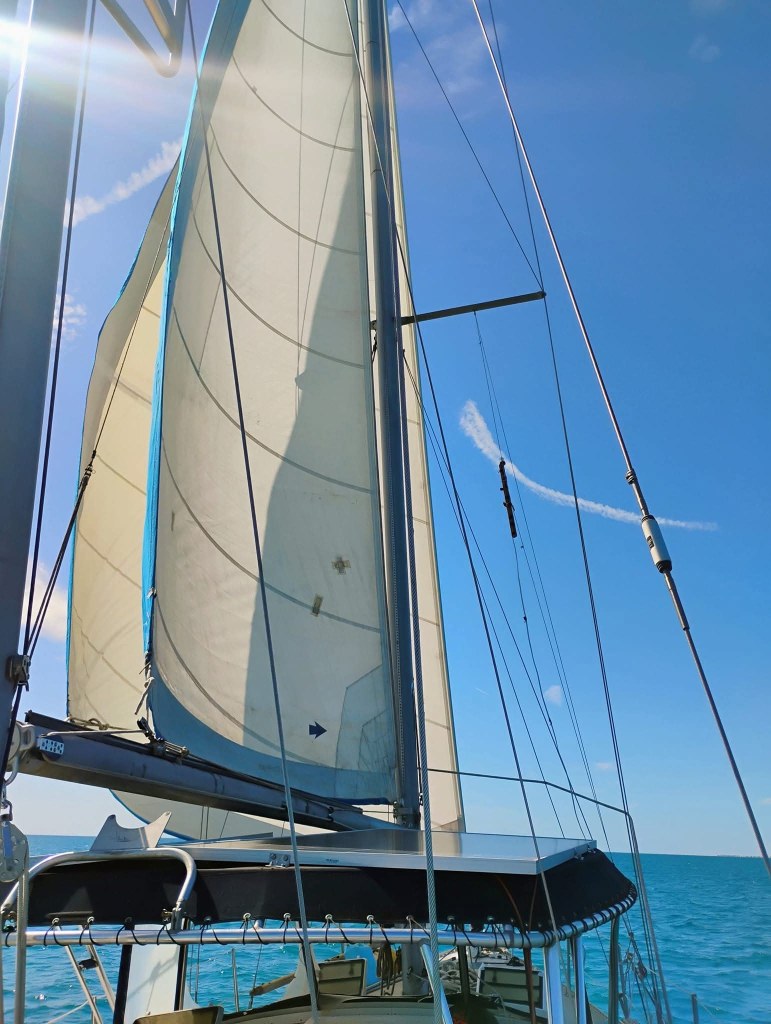
We were no longer land people. We were the hands of the Morgan 51. As we motored out of the boot key and headed toward the mouth of the cove, Moe looked back at the receding shoreline.
The adventure was no longer a dream on a screen; it was a 50-ton reality moving toward the open ocean.


 Gentle Trails journal